 AppView
Chrome Web Store analytics for people who build, market or buy extensions. The store shows today's numbers; AppView keeps the history.
Screens
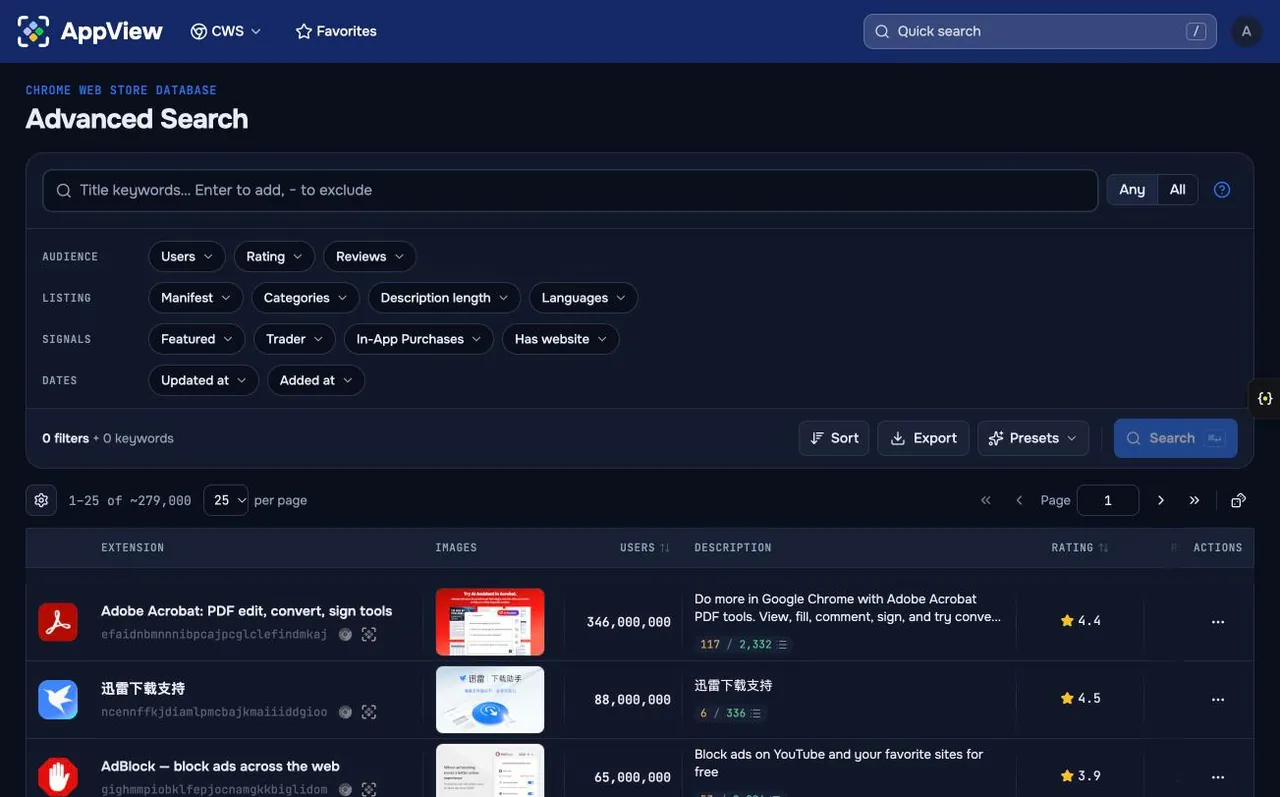
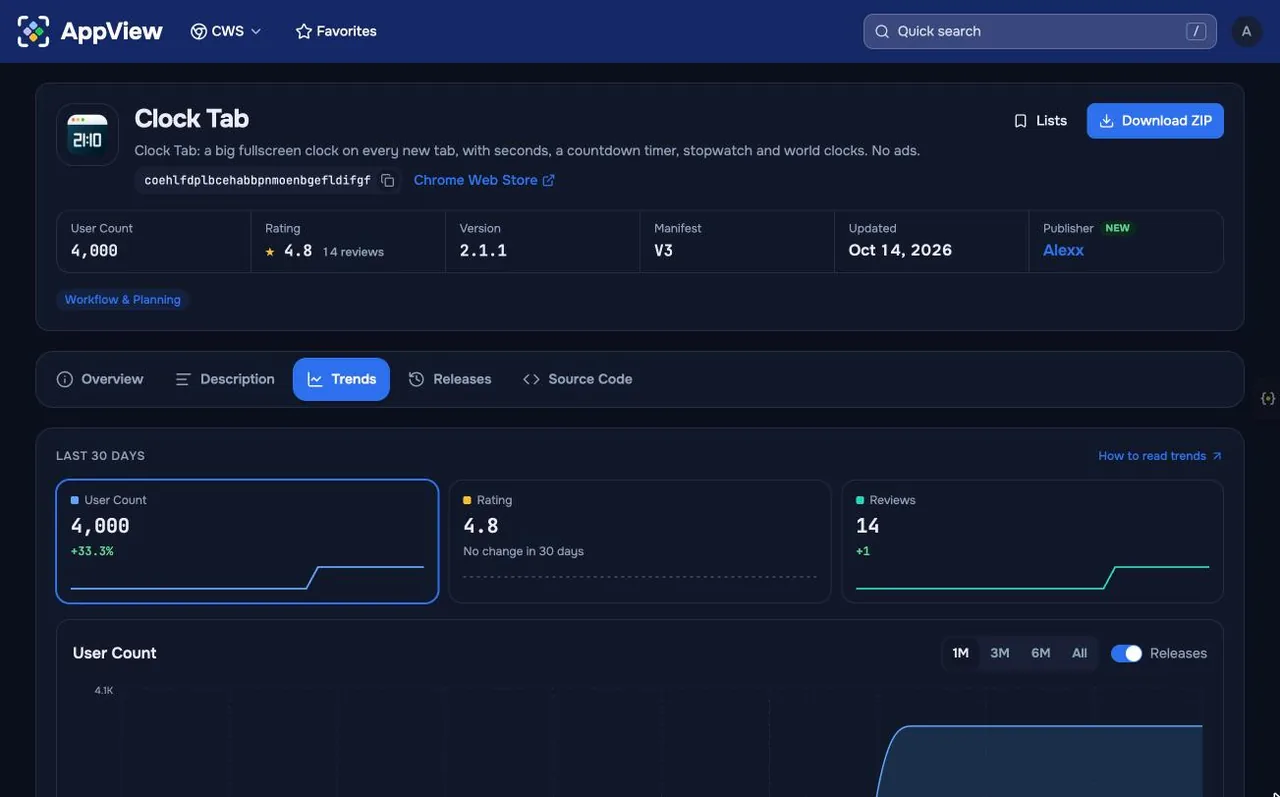
The problem
People who build, market or buy browser extensions can’t see who leads a niche, how fast competitors grow or what changed between versions. The store page shows today’s numbers and nothing else.
Results
Payments per month went from 3 in the first months to 44, then to a peak of 55. The first sales channel was a design partner: a community of extension builders. Customers from that warm audience convert at about 8%, against about 1% for cold traffic. A 7-day trial without a card now tests the cold audience; it’s launched and the result is being measured.
What the product does
- History of users, rating, reviews, versions and titles for ~426k store items and ~118.6k publishers, kept since January 2025.
- Advanced search with dozens of filters and XLSX/CSV export, also for finding competitors by keyword or audience.
- Publisher rankings: largest audience, fastest growth, most active, with a verified signal.
- Lists, package download and a source viewer for archived versions.
- A recommendation graph of 2.84M links between ~252k extensions.
- Freemium with Premium: 30 days of history free, paid gates where the value shows up.
- Next: mobile app stores.
How it reaches people
- Content site on Next.js built for search and AI answers (llms.txt, schema.org).
- Telegram bot with a bonus for linking an account.
- Chrome extension.
- Five interface languages.
Product cases
- Landing: entry bundle cut from 1.9 MB to 189 KB with prerendering; local Lighthouse mobile went from 67 to 92–94. Production measurement pending.
- Search: the result count dropped from ~540 ms to ~20–30 ms. A full advanced-search request runs at p50 ~173 ms and p95 ~492 ms in production (~5,000 requests over 7 days).
- History storage: TimescaleDB with compression on sparse data, so the database grows by tens to hundreds of MB a year instead of hundreds of GB.
- Reliability: a backup before every deploy, a restore drill of 718 MB in 2 min 35 s, a runbook per release; Sentry noise down from ~100 events a day to ~12 a night.
- LLM where it pays off: rules first, the model only for the top candidates, results cached by input hash.
How it’s built
15 services in Docker Compose and five surfaces: web app, content site, Chrome extension, Telegram bot and admin. About 1,740 backend and 575 frontend tests. Decisions are recorded in 15 ADRs and a 65-entry decision log.
I wrote the system by hand through mid-2026. Since then AI coding agents implement to my specs, and I accept the work against tests and production measurements. Agents joined the team; the job is still the result.
Need something like this?
Tell me what you have and how I can help.